
The Complete Guide to Therapeutic Exercises
Why Therapeutic Exercise Matters for Your Recovery

Therapeutic exercises are planned movements prescribed by a healthcare professional to address physical problems and restore function. Unlike general workouts, these exercises are chosen for your specific needs, targeting the root cause of issues like back pain, limited mobility, or injury recovery.
The key difference is the prescription. A chiropractor or physical therapist designs a program to address a specific problem, such as tight muscles, a weak core, or poor joint movement. Research shows this targeted approach can reduce pain, improve strength, and help you return to daily activities faster.
Hi! I'm Dr. Michelle Andrews, founder of ChiroHer in Oklahoma City. I use therapeutic exercises to help my patients recover from injuries, manage chronic pain, and move better. As a Webster Technique certified chiropractor with training in prenatal care and sports recovery, I've seen how the right exercises can transform a person's quality of life.
Introduction to Therapeutic Movement
At ChiroHer, we see therapeutic exercises as a key part of holistic health. It is a precise approach to movement prescribed to address impairments, restore function, and maintain well-being.
Our primary goal is to address the root causes of your discomfort. This involves:
Addressing Impairments: Identifying and managing specific weaknesses, imbalances, or restrictions in your body.
Restoring Function: Rebuilding strength, flexibility, and coordination after an injury, surgery, or due to a chronic condition.
Supporting Well-being: Empowering you with tools to maintain your health and prevent future issues.
How Therapeutic Exercise Differs from General Physical Activity
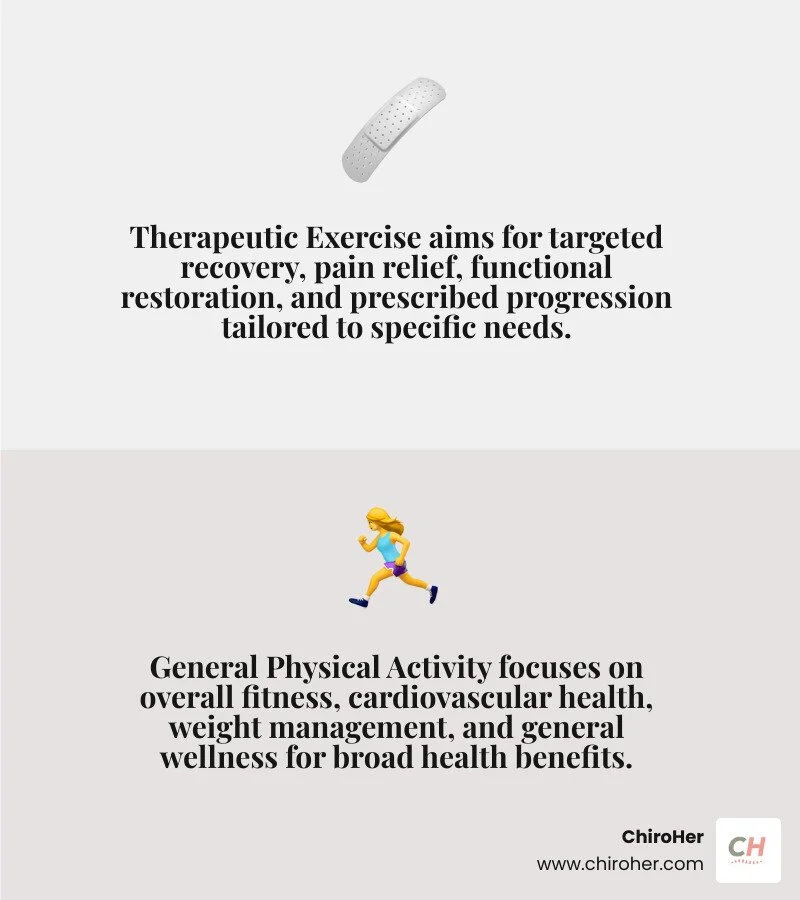
While general physical activity like walking or gardening is great for overall health, therapeutic exercises are different. They are specifically chosen by a healthcare professional to achieve a therapeutic outcome.
Therapeutic exercises are:
Prescribed: Chosen by a professional for a specific goal.
Targeted: Focused on addressing a particular impairment, not just general fitness.
Progressive: Designed to increase in difficulty as your body heals and strengthens.
Goal-Oriented: Aimed at restoring function, reducing pain, and improving physical abilities.
Types of Therapeutic Exercises
Therapeutic exercises are categorized into several key types. A comprehensive program will often incorporate elements from each to ensure holistic recovery.

Endurance Exercises
Also called aerobic exercises, these improve cardiovascular health and stamina. Activities include brisk walking, swimming, or cycling, helping your body sustain activity over time.
Resistance Exercises
Resistance or strength training builds muscle strength and endurance by working against a force. This is important for supporting joints, improving posture, and enhancing daily movements.
Flexibility and Mobility Work
These exercises increase your range of motion and lengthen muscles, reducing stiffness. Common types include:
Static Stretching: Holding a stretch for 15-30 seconds.
Dynamic Stretching: Using controlled movements through a full range of motion.
PNF Stretching: Advanced techniques that contract and relax muscles for greater flexibility.
Balance and Coordination Activities
These exercises improve your ability to maintain equilibrium, which is important for preventing falls and enhancing athletic performance. Improved postural control can reduce the risk of injuries like ankle sprains.
Common Equipment
While many exercises use only body weight, some common tools include:
Resistance bands
Stability balls
Foam rollers
Light dumbbells
Yoga mats
For more specific goals, we may also use Plyometric Exercises or Functional Movement Exercises.
How to Prescribe and Monitor Therapeutic Exercise
Effective therapeutic exercises are carefully planned and monitored by our chiropractors at ChiroHer to ensure safety and optimal results.

FITT Principle
We use the FITT principle to design safe and effective programs:
Frequency: How often you perform the exercises.
Intensity: How hard you work during each session.
Time: The duration of each session.
Type: The specific exercises chosen for your condition.
Individualization and Progressive Overload
Every program is customized for the patient, considering factors like age, condition, and personal goals. As you get stronger, we apply the principle of progressive overload by gradually making the exercises more challenging. This ensures your body continues to adapt and improve.
Safety and Monitoring
We carefully consider when exercise is appropriate (indications) and when it should be avoided (contraindications). Your safety is our priority. We reduce risks by:
Providing clear instruction on proper form.
Monitoring your progress and adjusting your plan.
Modifying movements if you experience any pain.
We measure effectiveness by tracking reduced pain, improved range of motion, increased strength, and better functional ability. For more on exercise guidelines, you can review resources like this Scientific research on exercise guidelines from the National Library of Medicine.
Benefits and Uses of Therapeutic Exercise
Therapeutic exercises can help manage physical challenges, leading to significant improvements in health. At ChiroHer, we see these benefits daily across our patient base in Oklahoma City, Mustang, and Moore.

Common Applications
Musculoskeletal Conditions: For issues like back pain and osteoarthritis, targeted movements can strengthen supporting muscles, improve flexibility, and reduce pain.
Chronic Disease Support: Exercise plays a role in managing conditions like diabetes by improving glucose metabolism and cardiovascular health.
Post-Surgical Recovery: A guided exercise program helps restore range of motion, rebuild muscle, and improve independence after surgery.
Injury Prevention: By strengthening vulnerable areas and improving balance, we can reduce the risk of future injuries, which is especially important for athletes. Learn more about our approach to Sport Injury and Rehabilitation.
Adapting for Specific Populations
We adapt programs for unique needs:
Older Adults: We focus on balance, aerobic activity, and strength to reduce fall risk and maintain independence.
Athletes: Programs are designed to improve performance and prevent sport-specific injuries.
Prenatal Clients: For expecting mothers, exercises help manage discomfort and prepare the body for childbirth and recovery. See our Benefits of Prenatal Chiropractic Care for more on our specialized approach.
Common Therapeutic Exercises You Can Try
While a personalized plan is always best, here are some common therapeutic exercises. Always listen to your body and stop if you feel sharp pain.
Exercises for Back Pain
For more, see our Low Back Pain Relief Guide.
Knee-to-Chest Stretch: Lie on your back, bring one knee to your chest, and hold for 5-10 seconds. Repeat with the other leg, then both.
Cat-Cow Stretch: On your hands and knees, alternate between arching your back (inhale) and rounding your spine (exhale). Repeat 3-5 times.
Bridge Exercise: Lie on your back with knees bent. Lift your hips to form a straight line from shoulders to knees. Hold for 3-5 seconds, then lower.
Exercises for Sciatica
Find more stretches in our Sciatica Exercises guide.
Piriformis Stretch: Lie on your back and cross one ankle over the opposite knee. Gently pull the uncrossed knee toward your chest and hold for 30-45 seconds.
Seated Rotational Stretch: Sit in a chair and cross one leg over the other. Gently twist your torso toward the bent knee and hold for 10 seconds.
Exercises for Arthritis
Focus on maintaining mobility and strength without pain.
Gentle Range of Motion: Slowly move the affected joint through its available range.
Isometric Strengthening: Contract the muscle without moving the joint (e.g., tighten your thigh muscle).
Balance Exercises: Practice standing on one leg, holding onto support if needed.
Correct Posture Exercises
Improve your posture with these moves. See our full Correct Posture Exercises guide for more.
Chin Tucks: Gently pull your chin straight back, creating a double chin. Hold for 1-2 seconds and release. Repeat 10 times.
Thoracic Extension: With hands behind your head, gently arch your upper back and squeeze your shoulder blades. Hold for 1-2 seconds. Repeat 10 times.
Working with a Healthcare Professional
For the safest and most effective recovery, work with a qualified healthcare professional for your therapeutic exercises.
Role of Chiropractors and Physical Therapists
At ChiroHer, our chiropractors are skilled in assessing and managing movement-related conditions. We evaluate your movement, identify dysfunctions, and prescribe specific exercises to complement chiropractic adjustments. This is part of a comprehensive approach to care that may also involve physical therapists, who are also specialists in using exercise to restore function and reduce pain.
Personalized Plans and Proper Technique
A one-size-fits-all approach doesn't work. We create personalized exercise plans based on your age, condition, and goals. Our primary focus is ensuring you perform each exercise with proper technique to maximize benefits and prevent injury. We provide clear instruction, demonstrations, and feedback to guide you safely.
Our Manual Therapy Guide shows how hands-on techniques support exercise therapy. To understand our full scope of practice, see What Does a Chiropractor Do?.
Making Therapeutic Exercise Part of Your Routine
Integrating therapeutic exercises into your daily life is key to long-term success. We support our Oklahoma City, Del City, and Nichols Hills community in making movement a part of their health.
Tips for Success
Start Safely: Always consult a healthcare professional before beginning a new program. We will assess your condition and prescribe appropriate exercises to prevent injury.
Listen to Your Body: Differentiate between the feeling of a muscle working and sharp pain. Stop any exercise that causes increasing or sharp pain.
Build Consistency: The benefits come from regular practice. Aim to perform your exercises as instructed, even if it's just for a few minutes each day. Consistency is more effective than infrequent, intense sessions.
The ChiroHer Approach
At ChiroHer, we provide patient-focused care. We don't just give you a list of exercises; we educate you on why each movement is important for your condition. We empower you to take an active role in your health.
Ready to take the next step?
Building Trust: The Science Behind Therapeutic Exercise
At ChiroHer, our approach to therapeutic exercises is rooted in science. We use evidence-based practice, which combines the latest research, our clinical expertise, and your personal goals to create an effective treatment plan.
How Research Supports Therapeutic Exercise
The effectiveness of therapeutic exercise is well-documented in research:
Musculoskeletal Disorders: Studies show exercise therapy is effective for reducing pain and improving function in people with conditions like back pain and knee osteoarthritis.
Chronic Disease Management: Exercise is a powerful tool for managing chronic diseases. It can improve aerobic fitness after a stroke and help manage diabetes by improving glucose metabolism.
Fall Prevention: For older adults, therapeutic exercise is proven to improve balance and reduce the risk of falls.
Post-Surgical Recovery: Research highlights the effectiveness of guided exercise in recovery from various surgeries and injuries.
Correctly prescribed movement is a form of medicine, supported by extensive clinical research.
For more information on the benefits of physical activity, we recommend these sources:
The information, including but not limited to, text, graphics, images and other material contained on this website are for informational purposes only. No material on this site is intended to be a substitute for professional medical advice, diagnosis or treatment. Always seek the advice of your physician or other qualified health care provider with any questions you may have regarding a medical condition or treatment and before undertaking a new health care regimen, and never disregard professional medical advice or delay in seeking it because of something you have read on this website.