
15-Minute Back Bliss: Daily Stretches for Lower Back Pain Relief
Your 15-Minute Path to a Happier Back
Stretches for lower back pain can provide significant relief in just minutes a day. If you're looking for quick answers, here are the most effective stretches:
Top Stretches for Relief:
Knee-to-Chest Stretch - Lie on your back, pull one knee toward your chest, hold for 30 seconds
Cat-Cow Pose - On hands and knees, alternate between arching and rounding your back
Piriformis Stretch - Cross one ankle over opposite knee, pull gently toward chest
Lower Back Rotation - Lie on back with knees bent, gently roll knees side to side
Bridge Pose - Lift hips while lying on back with knees bent
Pelvic Tilt - Flatten lower back against floor by engaging core muscles
Hold each stretch for 20-30 seconds and repeat 2-3 times. Perform these daily for best results.
Most American adults will experience lower back pain, and over 25% are dealing with it right now. The good news is that research shows gentle movement is more effective than rest for easing this pain.
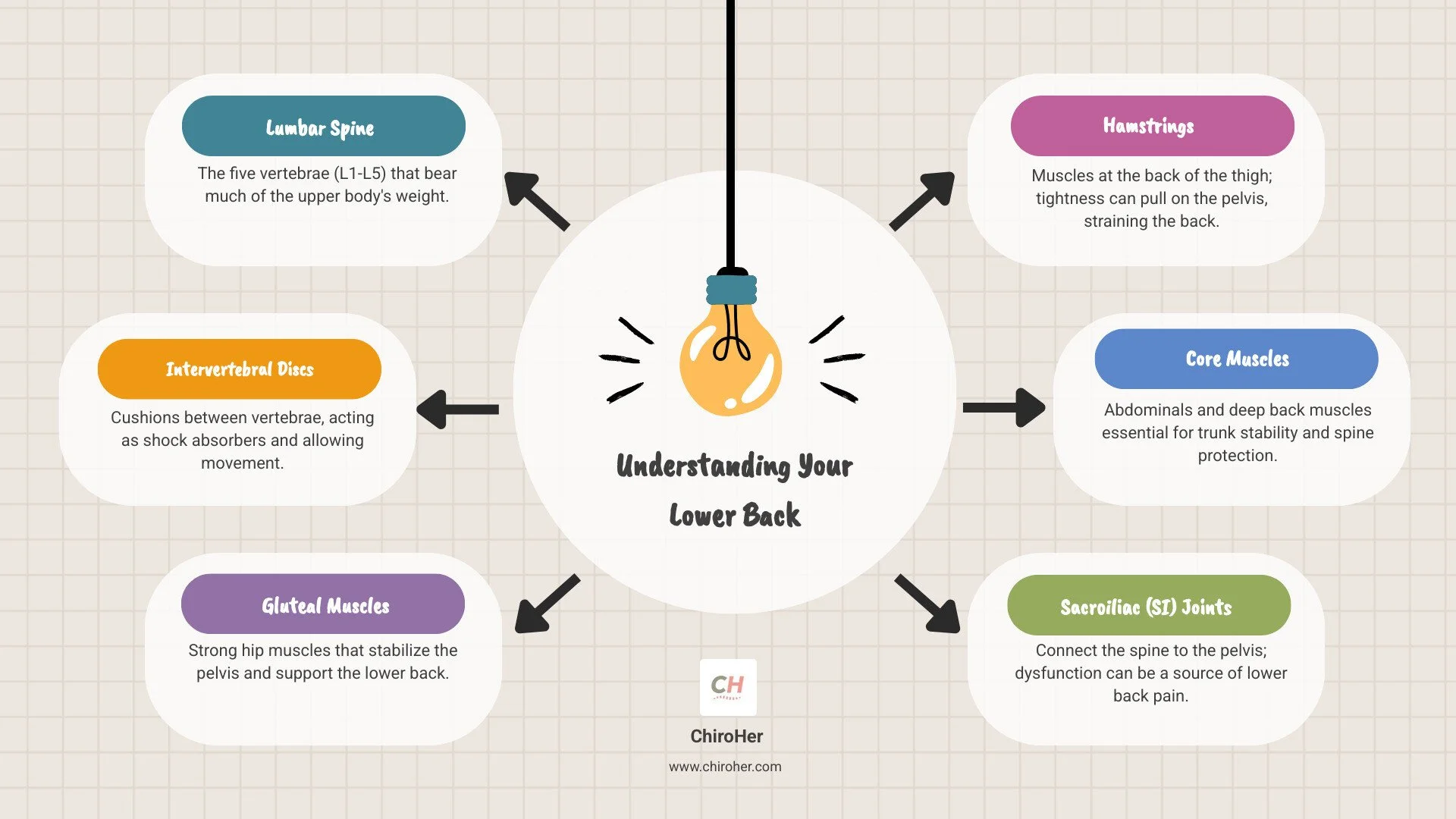
Your lower back supports most of your body's weight. Pain often follows when the muscles around your lumbar spine, hips, and hamstrings get tight or weak. A simple 15-minute daily routine of targeted stretches can make a real difference.
While many think rest is the answer, staying still can worsen stiffness and pain. Stretching improves flexibility, reduces muscle tension, and helps restore normal movement.
This guide offers a practical routine of effective stretches you can do at home. You'll learn how to perform them safely and when to seek professional help.
Hi! I'm Dr. Michelle Andrews, founder of ChiroHer in Oklahoma City. I've worked with hundreds of patients to develop personalized stretches for lower back pain that fit into busy schedules. Throughout my practice, I've seen how consistent, gentle stretching transforms lives, helping people get back to work, play with their kids, and sleep through the night without discomfort.
A Guide to Stretches for Lower Back Pain
Low back pain affects millions. Our lumbar spine bears a significant portion of our body's weight, making it prone to discomfort. Common causes include muscle strains from improper lifting, prolonged sitting, or poor posture. These activities put stress on the spine, leading to muscular imbalances.
Tight hamstrings and hip flexors can pull on your pelvis, altering spinal alignment. A weak core offers less support, making your back more vulnerable to injury.
The good news is that regular physical activity and stretching can soothe existing pain and prevent it from returning. Research shows that self-administered stretching can be highly effective for managing chronic non-specific low back pain.
Understanding the root causes of your pain is the first step toward finding relief. For more comprehensive information on back pain, you can explore our resources on Back Pain.
Gentle Stretches for Immediate Relief
When your back is stiff or sore, these gentle stretches can offer comfort. Move slowly and listen to your body; never push into sharp pain.
Knee-to-Chest Stretch: This stretch gently lengthens the muscles in your lower back.
How to perform: Lie on your back with your knees bent and feet flat on the floor. Gently pull one knee towards your chest, holding it with both hands.
Hold: 30 seconds.
Repetitions: Repeat 3 times for each leg.
Lower Back Rotational Stretch: This helps to release tension in the spinal muscles.
How to perform: Lie on your back with knees bent and feet flat, arms out to your sides in a "T" shape. Keeping your shoulders flat, gently roll both knees to one side.
Hold: 15-20 seconds.
Repetitions: Repeat 5-10 times on each side.
Cat-Cow Pose: This movement mobilizes the spine and warms up the back muscles.
How to perform: Start on your hands and knees. As you exhale, round your spine (Cat). As you inhale, arch your back (Cow).
Hold: Hold each position for 5-10 seconds.
Repetitions: Flow between poses 15-20 times.
For more stretches that can help with nerve-related discomfort, explore our specific guidance on Sciatic Nerve Stretches.
Key Stretches for Hips and Hamstrings
Tight glutes and hamstrings often contribute to back pain by pulling on the pelvis and affecting spinal alignment. Stretching them can alleviate this tension.
Piriformis Stretch (Figure-Four): This targets a deep gluteal muscle that can affect the sciatic nerve.
How to perform: Lie on your back with knees bent. Cross one ankle over the opposite knee. Gently pull the non-crossed leg towards your chest.
Hold: At least 30 seconds.
Repetitions: Repeat 2-3 times for each leg.
Seated Hamstring Stretch: This is an easy way to stretch hamstrings tightened by prolonged sitting.
How to perform: Sit on the floor with one leg extended. Bend the other knee, placing the sole of that foot against your inner thigh. Hinge forward at your hips with a straight back.
Modifications: If you can't reach your foot, loop a towel around it and gently pull.
Hold: 10 seconds, rest for 30 seconds.
Repetitions: Repeat 3 times for each leg.
Maintaining proper hip alignment is vital for back health. Learn more about Hip Alignment Stretches.
Foundational Exercises to Strengthen Your Core
A strong core provides stability for your lower back, reducing pain and preventing future issues. The core includes deep abdominal muscles, back muscles, and muscles around the pelvis.
Bridge Pose: This exercise strengthens your glutes and lower back.
How to perform: Lie on your back with knees bent, feet hip-width apart. Engage your core and glutes to lift your hips, forming a straight line from shoulders to knees.
Hold: For 3 deep breaths (5-10 seconds).
Repetitions: Repeat 5-10 times, working up to 30.
Pelvic Tilt: This subtle movement engages deep core muscles.
How to perform: Lie on your back with knees bent. Gently flatten your lower back against the floor by tightening your abdominal muscles.
Hold: 6 seconds.
Repetitions: Repeat 8-12 times.
Bird-Dog (Alternate Arm and Leg): This exercise builds core stability and balance.
How to perform: Start on your hands and knees. Keep your back flat as you slowly extend your right arm forward and your left leg back. Maintain a stable torso.
Hold: 6 seconds, working up to 30 seconds.
Repetitions: Repeat 8-12 times on each side.
Strengthening your core and improving functional movement are cornerstones of a healthy back. We have more resources on Functional Movement Exercises that you might find helpful.
Creating Your Routine and When to Seek Help
A consistent daily habit is key to long-term relief. We know life in the Oklahoma City area, including Yukon, Edmond, and Moore, can be busy, but just 15 minutes a day can make a huge difference.
Here's a sample 15-minute daily routine:
Warm-up (1 minute): Gentle marching in place.
Knee-to-Chest Stretch (2 minutes): 30 seconds per leg, 3 repetitions.
Cat-Cow Pose (2 minutes): 5-10 second holds, 15-20 repetitions.
Piriformis Stretch (2 minutes): 30 seconds per leg, 2 repetitions.
Pelvic Tilt (2 minutes): 6-second holds, 10 repetitions.
Bridge Pose (3 minutes): 5-10 second holds, 5-10 repetitions.
Bird-Dog (3 minutes): 6-second holds, 8-12 repetitions per side.
Consistency is the most important part. While results aren't immediate, regular practice over a few weeks can improve flexibility and reduce pain.
Safety Tips for Your Stretching Practice
To stretch safely and effectively, keep these tips in mind:
Listen to your body: A stretch should be a gentle pull, not sharp pain. Stop if you feel sharp, shooting, or increasing pain.
Warm up: Before stretching, do a few minutes of light cardio like walking in place to get your blood flowing.
Avoid bouncing: Hold stretches steadily. Bouncing can cause muscle contraction and injury.
Don't push into pain: Mild discomfort is normal, but pain is a sign you're pushing too hard.
Breathe: Breathe deeply during each stretch. Holding your breath increases tension.
Use modifications: If getting on the floor is difficult, many stretches can be done standing or seated. We can help you find modifications that work for you.
For more personalized guidance, our team offers specialized Therapeutic Exercises custom to your needs.
Can stretching help with sciatica?
Sciatica is pain that radiates down the leg, caused by compression or irritation of the sciatic nerve. This can be due to a herniated disc or a tight piriformis muscle (piriformis syndrome).
Stretches that can help with sciatica include:
Piriformis Stretch (Figure-Four): This directly targets the piriformis muscle, which can press on the sciatic nerve.
Knee-to-Chest Stretch: This can help gently decompress the lower spine.
While these stretches can help, see a professional for severe or constant pain, progressive numbness or weakness in your leg, or changes in bowel or bladder function. These may indicate a more serious condition.
For a deeper understanding of this condition, visit our page on Low Back Sciatic Pain.
When to Seek Professional Help
While home stretching is effective, some situations require professional medical advice. Watch for these red flags:
Pain that persists: See a doctor if pain lasts more than a few weeks despite self-care.
Numbness or weakness: Worsening numbness, tingling, or weakness in your legs, feet, or groin requires professional evaluation.
Pain after an accident: Get checked immediately if pain follows a fall or accident.
Other symptoms: Seek urgent care for back pain with fever, unexplained weight loss, or loss of bowel/bladder control.
Pain that disrupts life: If pain is severe or worsening and interferes with daily activities, it's time to get help.
At ChiroHer, we offer personalized chiropractic care to address the root cause of your discomfort. By restoring proper motion and alignment to your spine, we help your body heal, aiming for long-term stability and wellness. Our award-winning, patient-focused team serves the Oklahoma City area, including Yukon, Edmond, Nichols Hills, Del City, Mustang, and Moore. Led by Dr. Michelle Andrews, we listen to our patients and develop custom plans to help you achieve a healthier back.
We invite you to learn more about our comprehensive Chiropractic Care services. If you're ready to take the next step toward a pain-free life, we encourage you to Schedule Consultation with us today. We're here to help you move better, feel better, and live better.
This article is for informational purposes only and does not constitute medical advice. The information contained herein is not a substitute for, and should never be relied upon for, professional medical advice. Always seek the advice of your physician or other qualified health provider with any questions you may have regarding a medical condition.